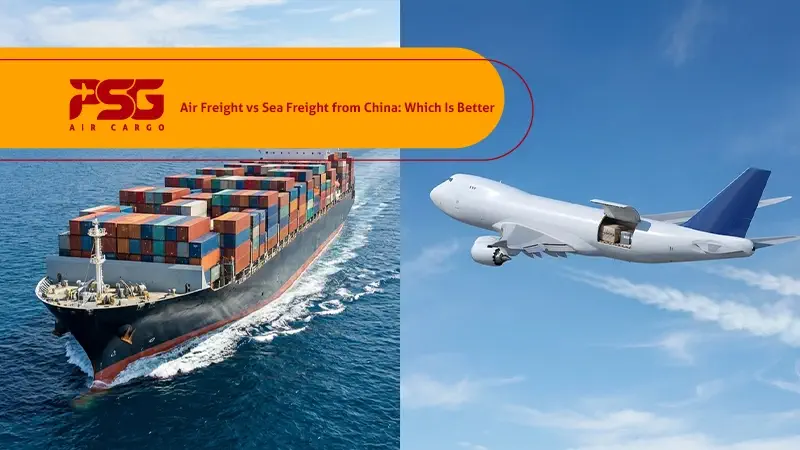
Air freight or sea freight from China is what importers and exporters struggle to choose based on their business type. In today’s world, China is the beating heart of global manufacturing. From electronics and industrial machinery to clothing, household appliances, and raw materials, China meets a large share of international market needs. But success in importing from China does not end with cheap purchases; it depends on how goods are shipped. Here is where the importance of shipping by air or by sea comes into play. This article explains everything you need to know about cargo transportation from China, whether through air or sea. Therefore, if you are a business owner who is new to the field of logistics, import, and export, this article is for you, as making the wrong choice between air freight and sea freight from China can multiply the final cost and cause delayed delivery. For this reason, a precise, deep, and professional understanding of the difference between these two methods is a real competitive advantage for every importer and exporter. In this article, we will examine in detail the advantages and disadvantages of air freight and sea freight, and what type of goods and businesses each is more suitable for.
How Does International Shipping from China Work?
Shipping from China is a series of interconnected steps called logistics Chain and includes receiving goods from the factory or supplier in China, doing the
standard export packaging regarding the destination regulation, then domestic transportation in China by road to the ports, carrying out export customs formalities, and the main part, which is sea or air transportation. Upon arrival, the process includes unloading at the destination country, customs clearance, and final delivery. It is important to understand that the main transportation method (air or sea) determines how the entire process is managed.
The Role of Global Conditions in Choosing a Shipping Method from China
The choice of shipping method from China in today’s world is more dependent than ever on variables beyond the control of traders. The global economy is so interconnected that any political, economic, or environmental change can alter the path of goods’ movement. China, as the world’s main manufacturing hub, is the most affected by these fluctuations. Unexpected events, such as regional conflicts, trade restrictions, or changes in countries’ customs policies, can suddenly make some routes expensive or even unusable. These conditions force companies to switch between shipping methods and to redefine their short- and long-term strategies. In unstable conditions, air transport is usually the first option to be affected. Limited capacity, strong dependence on energy prices, and high sensitivity to global disruptions cause its rates to increase rapidly and become less predictable.
In contrast, methods such as sea or combined transport, although slower, are relatively more stable in periods of crisis. Rising fuel prices are also a key factor that directly changes the structure of transportation costs. This means decisions are not based solely on speed, and factors such as profit margins, the type of goods, and risk tolerance become more important. Global conditions play a decisive role in choosing a transportation method. Merchants with a more analytical view of international developments and who use diverse logistics models can control costs and maintain their supply chain in an unstable global trade environment.
What is Sea Freight from China?
Sea freight refers to the transport of goods via cargo and container ships and is the backbone of global trade. More than 80% of the world’s international trade is carried by sea. Sea freight from China is a common and economical method of transporting goods in global trade. This method is popular due to its low cost for bulky goods, offering very high capacity, the ability to carry a variety of goods, and its flexibility in volume. Sea freight is divided into two types: full container load (FCL) and less-than-container load (LCL). Below is a detailed description of these two methods, along with their specific advantages. Types of sea freight containers from China vary, and the choice of container type directly affects the cost.
Full container load (FCL)
Full container load (FCL) is a method in which the entire container is dedicated to one owner of the goods. This method has specific advantages, including more security, faster unloading time, and suitability for bulky cargo.
Less than Container Load (LCL)
Less than container load (LCL) is a method by which several cargoes are loaded into a single container. Low cargo volumes and lower costs for small shipments are among the key advantages of this mode of transportation.
Choosing Between FCL and LCL
When it comes to sea freight, the first important decision is whether to book a full container. If the volume of the goods is such that it fills a large part of the container space, using a dedicated container makes more sense. In this case, the process of loading to delivery is more direct, and there is no dependence on the timing of other shipments. In contrast, when cargo volume is limited, sharing container space with other shipments is an economical solution. This method allows the importer to import the goods without investing a lot of capital and maintain its supply flow. In this method, the goods must pass through additional stages, which can affect delivery time.
Besides that, in a dedicated container, there is greater control over the shipment’s conditions. Still, in a shared load, coordination among multiple shipments can increase the likelihood of delays or damage. For this reason, the type of goods and their sensitivity are important factors in choosing the right method. The right decision is made when the load volume, the expected delivery time, and the final cost are considered simultaneously. An informed choice between these two methods can directly impact the profitability and efficiency of the supply chain.
Key advantages of sea freight
- Very affordable
As the cheapest international shipping method, it is suitable for wholesale and commercial imports and offers a lower per-unit cost.
- Very high carrying capacity
There is a Possibility of carrying bulky, heavy goods that make it suitable for machinery, raw materials, and industrial equipment.
- Flexibility in cargo type
Sea freight offers various container types, enabling the carriage of all kinds of goods.
- Suitable for long-term supply chains
It is Sustainable, economical, and scheduleable for regular imports.
- More environmentally friendly
This method is less polluting than air freight.
Main Challenges of sea freight
- Long shipping time
Transporting cargoes usually takes between 30 and 50 days, making it suitable for non-urgent goods.
- Risk of delay
Many factors can affect delays, including port congestion, weather conditions, and shipping line problems.
- More logistical complexity
Seaport logistics is complex and requires careful planning, warehouse and inventory management, and adherence to port formalities.
- Risk of damage to goods
One of the biggest risks is the humidity.
What is Air Freight from China?
In air freight, time is of the essence, making it the first choice in emergencies. The ability to ship goods in short time frames makes geographical distances less important and distant markets more accessible. This type of transport is usually used for goods where delayed delivery could result in financial loss or lost business opportunities. Products with short life cycles, luxury items, medical devices, and prototypes are among the cargoes that are most compatible with air transport. From an operational perspective, air transport processes are structured and standardized. Strict security controls, specialized packaging, and advanced tracking systems provide high transparency in the movement route. This reduces operational risks and increases plannability. Despite these advantages, air transport requires careful cost management. Capacity constraints, volumetric weight calculations, and market-driven requirements make this method a strategic decision. As a result, it works best when speed, accuracy, and reliability are prioritized over cost.
Main Advantages of Air Freight
- Very high speed
The most important advantage of air freight is the short delivery time.
Delivery of goods is usually within 2 to 7 business days.
Suitable for competitive markets and urgent goods.
- High reliability
Flight schedules are regular and predictable, and delays are less than sea freight.
- Greater security of goods
A short transit time reduces the risk of damage or theft. Besides that, airports usually implement strict security measures to protect expensive and sensitive goods.
- Reduced capital investment
Faster market entry, reduced need for large inventory, and improved cash flow are among the main advantages of air freight.
- Suitable for sensitive goods
If the sensitivity of goods is the highest priority, air freight shipping is the best choice. Medicines, medical equipment, electronics, luxury goods, samples
Disadvantages of Air Freight
- Very high cost
Air freight is the most expensive method of transportation. The cost is calculated based on actual weight or volumetric weight.
- Weight and volume restrictions
Suitable for small, light loads, but very expensive to transport bulky or heavy loads.
- Restrictions on the type of goods
Restrictions on the transport of batteries, liquids, hazardous materials, and strict security regulations
- High environmental pollution
Air transport has the highest carbon dioxide emissions.
Sea Freight vs Air Freight: Main Differences
One of the main differences between air and sea freight is reliability. Air transportation is more accurate, fast, and predictable, while sea freight is more stable but dependent on ports and global conditions. Another factor is that air freight from China is well-suited to online sales. Still, sea freight from China is more appropriate for major manufacturers and importers, and it has an economical supply chain. Regarding the environment, sea freight is more environmentally friendly; however, air freight causes high pollution.
Timing & Cost
Sea freight time varies depending on the destination, shipping line, and port conditions; it can range from 1 to 2 months. It is important to know that sea freight time is not just the time the ship is moving; it also includes loading, transit, unloading, and clearance.
Sea Freight Cost from China:
- Cheapest shipping method
- Suitable for bulk imports
- Cost based on the container and cubic meter
On the other hand, air freight from China is the fastest method of transporting goods in competitive markets and international trade. It is used for time-sensitive, valuable, or sensitive goods, which is why many online businesses prefer air freight over sea freight. The timing and cost of air freight depend on the service type. Below is a detailed breakdown of these air services, including their times and costs. It is important to know that air freight is calculated based on actual weight and volumetric weight. Sometimes, volumetric weight can make air freight much more expensive than expected.
Standard Air Freight
- Time: 5 to 7 days
- Cost: Medium to High
Express Air Freight
- Time: 2 to 4 days
- Cost: Very High
Volume & Weight
| Criteria | Air Freight | Sea Freight |
| Permitted Volume | Limited | Very High |
| Permitted Weight | Limited | Almost Unlimited |
| Heavy Goods | ❌ | ✅ |
Type of Goods
Products transported by air and by sea differ slightly. The most suitable goods for sea transport include machinery, raw materials, furniture, household appliances, and industrial goods.
On the other hand, air transport is most suited for goods such as electronics, mobile phones and laptops, medicine, medical equipment, and luxury goods.
Common Mistakes in Choosing a Shipping Method
In international trade, the choice of transportation method is one of the most important decisions that importers and exporters must make, as it directly affects costs, delivery time, risks, supply chains, and business profitability. The two main methods of international transportation are air freight and sea freight, each with its own benefits, features, and limitations. It is essential to understand that choosing the wrong method can cause irreparable problems, which is why conducting comprehensive research is vital. Here is a list of common mistakes businesses may make when selecting a shipping method.
- Choosing air freight for bulky cargo
- Ignoring volumetric weight
- Not having an inventory plan
- Not insuring goods
The Future of Shipping from China
In the future, transportation from China will be both a support activity and a strategic part of global trade. With the growth of international e-commerce and the increasing demand for faster delivery, China’s role in supplying goods to various markets will become more prominent, further increasing the volume of goods moved. In this direction, logistics will move away from a reactive mode and towards predictive planning. Besides that, companies will use digital systems to simulate different transportation scenarios, ensuring that an alternative route and the appropriate method are determined in advance before a disruption occurs. The environmental issue will also become a determining factor. Pressure from international institutions and countries’ domestic policies will gradually limit polluting transportation. As a result, methods that consume less energy or allow for carbon offsets will be prioritized. This shift in approach will fundamentally change the cost structure and choice of shipping routes from China. In addition, closer collaboration between manufacturers, shipping companies, and digital platforms will make the supply chain more integrated. This integration will increase transparency, reduce delay, and create greater trust in international trade. Ultimately, the future of shipping from China will be one in which intelligence, environmental responsibility, and operational agility form the three main pillars; factors without which success in the future global market will not be possible.
Sea Freight or Air Freight: How to Choose?
Air freight and sea freight both play vital roles in international trade, but they serve different purposes. Choosing wisely between these two methods will help you control costs, manage time, and increase your business’s profitability. The choice between these methods depends highly on goals. If your business’s main concern is delivery time, air freight is highly recommended, especially for high-value goods. High-value products often need to be transported by air because air transport poses fewer risks. The volume of cargo is also a major factor, as low-volume cargo is mostly shipped by air.
On the other hand, sea freight is suitable if the amount of the goods is high, the focus is on long-term planning, and the main concern is cost. Besides that, for commercial imports, sea freight is highly recommended. It is important to understand that sea freight is more cost-effective. Therefore, the choice between sea and air is not just a simple matter; it requires comprehensive research and the formulation of criteria.
How do I know which is best for my business?
Choosing the best option should not be based on a single factor. A careful examination of the following seven influential indicators acts as a roadmap and helps the decision-making process. When all these features are properly considered without skipping any stage of the review, the final result will be clear.
Time
If speed is critical for your business, and the market is waiting for your product, or you sell online, or a lack of inventory is causing you to lose customers, air shipping is better. However, if time is not a priority and you have inventory or have long-term planning, delays of a few weeks are not a problem; sea shipping is more suitable.
Value of the product
If the products are expensive and classified as high-value goods, air freight costs are reasonable relative to the goods’ value, and it is recommended to ship by air. However, for medium- or low-value goods such as household appliances, furniture, raw materials, and general consumer goods, air freight costs will kill your profit margins; therefore, sea freight is better.
Shipment Dimension
The size of cargoes is another important factor. If the cargo is light and small, for example, under 300-500 kilos, air freight is more economical and faster, especially for small volumes (small cartons).
Heavy or bulky cargo
If the weight is high and the containers are large, air freight becomes very expensive; therefore, Sea freight is the logical choice.
Business model; B2C or B2B
For B2C businesses (business-to-consumer), online sales, fast delivery, and customer satisfaction are important, which require air freight shipping. On the other hand, for B2B businesses (commercial and wholesale imports), manufacturing, distribution, and warehousing, sea freight is the best choice.
Inventory Management
If you do not have a warehouse, or even a small one, and fast delivery of goods is important, air freight is a better choice. However, if you have a warehouse to store inventory or seasonal planning, sea freight makes more sense and is more cost-effective than air freight.
Tolerance Risk
If delays are a problem for your type of business and you require precise scheduling, air freight is much safer. But if delays of even a few weeks are manageable, sea freight is a suitable option.
Quick decision table
The best method for a business is the one that maintains profit margins, manages capital wisely, and does not lose market time. However, combining air and sea freight is also a strategy that can work well for some businesses, as many successful companies have used it, helping keep costs under control.
| The Business Criteria | Better choice |
| Speed is important | Air freight |
| Cost is a priority | Sea freight |
| The cargo is bulky | Sea freight |
| The cargo is light | Air freight |
| High profit margin | Air freight |
| Bulk Import | Sea Freight |
| Online Sales | Air Freight |
Final Thoughts
Air freight or sea freight from China is a common question for importers working on the China logistics route. The differences between air and sea freight from China include speed, cost, the type of goods, and destination. Air freight from China is best suited for those seeking high speed, security, and flexibility. However, sea freight from China offers low cost, high capacity, and sustainability. The right choice between these two methods will make the import more cost-effective and the shipping process more profitable. PSG Air Cargo, as part of its services, offers air freight from China and supports the business’s worldwide growth. It also helps the business achieve a smooth, hassle-free shipment at every step, preventing delays and unexpected costs. This company provides customers with technological innovation at every step, including live tracking. Besides that, it offers enhanced strategies for those clients seeking high delivery speed.
FAQs
Is air freight always more expensive?
It depends, but air freight is usually more expensive than sea or land freight.
What factors are important in choosing a shipping method from China?
Goods dimension, shipping costs, destination infrastructure, and route flexibility.
When is air freight the best choice?
For valuable, sensitive, or urgent goods that require fast delivery, speed and security are more important than cost.



Leave a Reply
Want to join the discussion?Feel free to contribute!