The mainland and free zones serve as the primary destinations for import and export in the UAE. Nowadays, the United Arab Emirates is one of the most attractive destinations for starting a business or expanding an existing brand in the Middle East and worldwide. The country offers attractive legal and financial opportunities, especially for companies targeting markets in the Middle East, Africa, and Asia. In this article, we will compare both onshore (Mainland) and Free Zone on various factors, including ownership, customs clearance, documentation, and more.
Reasons why businesses choose the UAE
One of the main reasons businesses choose the UAE is its strategic geographic location, which connects markets across the Middle East, Africa, and Asia. Besides that, the UAE offers a stable economy and a friendly business environment, making it an appealing destination. Advanced infrastructure, including ports, airports, logistics networks, and high-end IT, as well as transparent trade laws that protect foreign investors, are among the other reasons behind the UAE’s attractiveness. Below is a list of the different reasons.
- Tax exemptions and economic incentives: Including long-term tax exemptions and free zone facilities.
- Presence of a skilled and multinational workforce: Access to international talent and a professional job market.
- Political and legal stability: Transparent legal system and protection of property rights.
- International trade opportunities: Possibility of exporting and importing without restrictions, especially through free zones.
Definition of the Mainland and Free Zone in the UAE
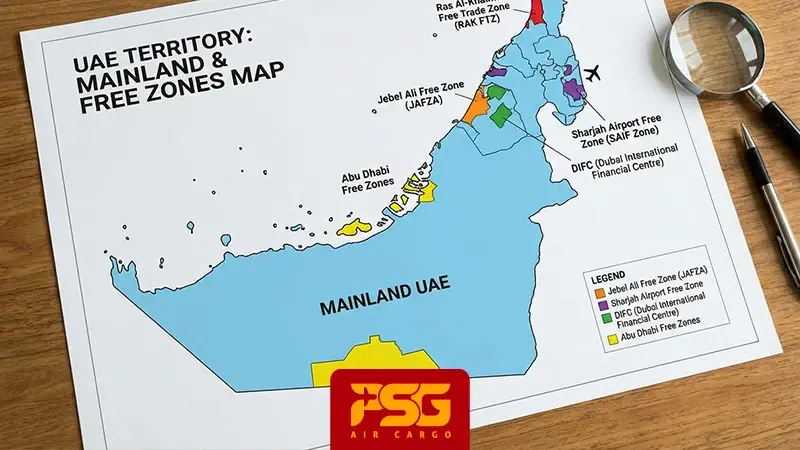
In the economic and administrative system of the United Arab Emirates, the country’s territory is divided into two main parts for economic and trade purposes: the Mainland and Free Zones. This division was formed to manage financial activities better and attract foreign investment.
Mainland
Mainland refers to all geographical areas of the United Arab Emirates outside the free zones, which are governed by the country’s general and federal laws. In these areas, all activities are subject to federal and local emirate laws governing commerce, finance, labor, and immigration. Officially, the mainland represents the country’s conventional economic structure, in which direct interaction with the domestic market, government institutions, and local consumers takes place.
Free Zones
Free Zones are special economic zones established within specific geographical areas and that have legal and regulatory frameworks independent or semi-independent of the country’s general laws. These zones are designed to facilitate trade, increase foreign investment, and develop international activities. In free zones, simpler laws, financial and administrative incentives, and dedicated management structures are applied, distinguishing them from the mainland.
Mainland Companies vs Free Zone Companies
Mainland Company
Mainland or Onshore companies can operate in all Emirates and are subject to federal business laws. The Department of Economic Development licenses these companies in each emirate, enabling them to operate throughout the UAE without geographical restrictions. These companies are allowed to participate in government projects, compete directly in the local market, and provide services to domestic customers.
Free Zone Company
Free zones are special economic zones designed to attract foreign investment. In these zones, companies are registered with a specific regional authority and benefit from certain financial exemptions, including a long-term exemption from corporate tax and import/export taxes. These types of companies usually experience a faster, simpler registration process with minimal government approvals and can use virtual offices or shared spaces to save costs.
Main Difference: Mainland Companies and Free Zone Companies
Ownership
In Free Zones, foreign individuals or entities may fully own businesses, with no legal requirement for Emirati citizen participation. On the Mainland, 100% foreign ownership is now possible for some business types; however, local requirements or considerations may still apply in certain areas.
Workplace requirements
In the Mainland, physical office space is required to meet local authority standards, and the company’s registered address must be real and verifiable. Additionally, the workspace must be appropriate for the type of activity, the number of employees, and municipal regulations. In contrast, Free Zones are more flexible, with many allowing for the use of virtual offices, shared spaces, or small offices. Therefore, a wider range of options is available, including small offices, shared space, and flexible working solutions, which help reduce operating costs.
Business scope
There are no geographical restrictions on Mainland operations, and direct operations are possible throughout the UAE. In Free Zones, activities are usually limited to the same region or international markets, and direct interaction with the domestic UAE market is subject to specific regulations.
Audit obligations
Companies operating in the Mainland are usually required to file annual audited financial statements in accordance with federal law. However, in Free Zones, audit requirements vary by region; some require the submission of an audit report, while others provide exemptions for small or start-up companies.
Set up the cost of a business
The cost of starting a business on the mainland is usually higher, due to requirements for office space, permits, and administrative processes. In the free zones, costs are often more transparent, packaged, and in many cases lower than on the mainland.
| Type of Cost | Mainland | Free Zone |
| Company registration costs | Usually higher | Usually lower |
| Office rent | Required and usually expensive | Virtual office and economical options |
| Visa costs | Dependent on office space | Determined by region |
| Corporate tax | 9% for high profits (UAE corporate tax) | Usually exempt |
Visa and work permits
Mainland: The possibility of issuing work visas to employees is subject to the regulations of the Economic Development Department and the Immigration Department of each emirate, and the number of visas depends on the size of the office and the type of activity. Free Zones: Each free zone has its own visa issuance system, which is often more flexible and faster, but the number of visas is limited by the zone’s capacity and the package selected.
Value Added Tax (VAT) regulations
Mainland: Companies are subject to corporate tax under federal law and Value Added Tax (VAT).
Free Zones: Many free zones are exempt from corporate tax for a certain period, and VAT rules apply similarly to free zones; however, domestic sales activities may be subject to VAT.
Customs clearance and regulations
Mainland: Companies must follow standard customs procedures, comply with export and import documentation requirements, and obtain the necessary permits from federal authorities. Free Zones: Free zones typically offer specialized warehousing and faster clearance, along with customs facilities for international exports and imports.
Regulatory authority and legal framework
Mainland: Supervision and licensing are carried out by the Department of Economic Development (DED) and other federal agencies. Free Zones: Each free zone has an independent regulatory authority with its own laws, which is responsible for licensing, inspecting, and monitoring activities.
Activity structure and legal scope
Mainland: Activities are subject to federal trade, labor, immigration, and regulatory laws, and any legal activity in the domestic market is possible. Free Zones: Activities are limited to the type of license issued and the scope of the zone; however, Free Zone companies are generally not allowed to operate directly in the domestic market.
Market access and distribution network
Mainland: Full access to the UAE domestic market and the ability to provide services and sell directly to local customers. Free Zones: Limited access to the domestic market; selling domestically often requires using a local distributor or partner.
Government contracts and partnerships
Mainland: Companies can participate in government projects and tenders, and enter into direct contracts with government entities.
Free Zones: Free Zone companies are generally not allowed to participate directly in government tenders and must apply through a local partner to enter this market.
Documentation
Mainland: All foreign documents and contracts must be submitted and approved in accordance with federal laws and international standards. Free Zones: Free zones often have simpler, faster processes for verifying foreign documents and offer certain legal facilities for global interaction.
Which is right for your Business: Mainland or Free Zone?
As a business owner, if you want to operate in the UAE domestic market and plan to participate in government projects, it is recommended to choose the Mainland. Besides that, if you plan to have a store or office or to provide face-to-face services in the UAE, choosing the Mainland is a better option. On the other hand, if the goal of your business is International trade and a physical presence in the UAE market is less important, you want to keep the costs of registering and maintaining the company low and secure full foreign investment without a local partner. It is better to select free zones. In short, if you have a limited budget and are focused more on international trade, a Free Zone can be a more cost-effective option.
Comparison Table: Mainland vs Free Zone
| Criteria | Mainland | Free Zones |
| Legal Nature | Part of the main territory of the country and subject to federal laws | Special Economic Zones with independent regulations |
| Registration and Supervisory Authority | Department of Economic Development (DED) of each emirate | Independent authority of each free zone |
| Foreign Ownership | Possibility of 100% ownership in many activities | 100% foreign ownership guaranteed |
| Access to the domestic market | Full and direct access to the UAE market | Limited; requires a special intermediary or license |
| Geographical scope of activity | Within the UAE | Limited to free zones and international markets |
| International activity | Allowed | Allowed and facilitated |
| Participation in government tenders | Allowed | Usually not allowed |
| Office space requirements | Physical office required | Virtual or shared office allowed |
| Set-up costs | Relatively high | Usually less and more transparent |
| Registration and start-up process | More formal and time-consuming | Faster and simpler |
| Audit requirements | Usually mandatory | Depending on regional laws |
| Minimum capital | Often nominal and optional | Depending on the region and the type of activity |
| Visa allocation | Depending on office size and the kind of activity | Depending on the region and laws |
| Corporate tax | Federally taxed by law | Often exempt or with tax incentives |
| Value Added Tax (VAT) | Federally taxed | Applicable; exports often exempt |
| Customs regulations | Subject to general customs laws | Special customs facilities |
| Legal structure of the business | Fully subject to federal laws | Subject to free zone-specific laws |
| Operational flexibility | Medium | High |
| Suitable for | Domestic market, local services, government projects | International trade, startups, exports |
Advantages and Disadvantages: Mainland vs Free Zone Companies
Mainland Companies
Advantages
- Full access to the UAE domestic market: Ability to sell directly to customers and companies across the country.
- Possibility of participating in government projects and tenders: Access to large contracts and government projects.
- Activity without geographical restrictions: Branches or offices can be established in any emirate.
- Possibility of 100% foreign ownership in many industries: With the new amendments to foreign investment laws.
Challenges
- Higher start-up and maintenance costs: Office rent, license, and administrative processes are relatively more expensive.
- More complex administrative and legal requirements: Compliance with federal laws, annual reporting, and auditing are mandatory.
- Requirement of physical office space: A real office with specific standards is essential.
- The registration process may be longer and more complicated.
Free Zone Companies
Advantages
- 100% foreign ownership: No local partner required.
- Quick and simple registration process: The setup process is shorter and less expensive.
- Tax and customs exemptions: Many free zones are exempt from corporate tax for a long time and offer export and import facilities.
- Workspace flexibility: Virtual offices and shared spaces are available.
Challenges
- Limited access to the UAE domestic market: Free zone companies are generally unable to trade directly with the Mainland market unless they use a local distributor. This local distributor or partner can sell domestically.
- Limitations on employee visas: The number of visas is limited by the zone’s capacity and the type of license.
- Limitations on domestic legal activities: There is no possibility of direct participation in government tenders.
Final Thoughts
The mainland and free zones are the primary destinations for importers and exporters, regardless of business scale, and the choice between the two depends on business goals, budget, target market, and type of activity. This article examined the main differences, advantages, and challenges of both. In short, if you want to operate directly in the UAE market and attract local customers, the Mainland option is the better choice. However, if you want to focus on international trade with lower costs and a simpler process, Free Zones are the best choice. PSG Air Cargo is a UAE-based logistics company that can help businesses that target both the mainland and free zones for import and export.
FAQs
Are there taxes in the UAE free zones?
Many UAE free zones offer tax exemptions, and some zones do not charge income tax on companies.
Which UAE Free Zone is Best for Starting a Business?
Choosing a free zone depends on the business type and specific needs.
Can I own 100% of the business in the UAE mainland?
On the mainland, most businesses require a local Emirati partner. However, in some specific cases, these restrictions may vary.



Leave a Reply
Want to join the discussion?Feel free to contribute!