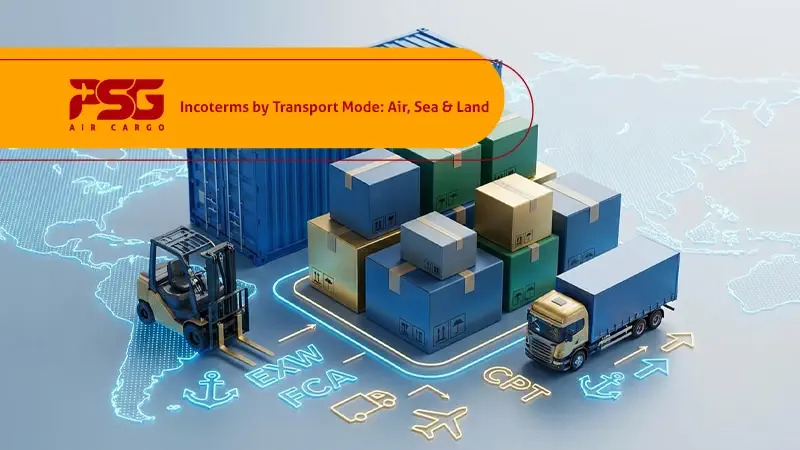
Incoterms are a global standard for determining the duties, responsibilities, costs, and risks of the parties to a transaction. In the world of international trade, differences in laws, languages, cultures, and transportation systems can lead to costly disputes between buyers and sellers. Incorrect use of an Incoterm can lead to unexpected costs, legal disputes, delivery delays, and an increased risk of damage or loss of goods. The latest official version of these rules is Incoterms 2020, which must be stated precisely in contracts. In this article, Incoterms are examined in a specialized and comprehensive manner by transport mode (sea, air, land), and each term is explained, along with the circumstances in which it should be used.
A Comprehensive Definition of Incoterms
Incoterms are a set of standard international trade terms developed by the International Chamber of Commerce (ICC) that define the responsibilities and obligations between the seller and the buyer in international transactions. In other words, Incoterms are part of the global sales contract and help prevent legal and financial misunderstandings by using short, standardized terms. These terms specify:
- Where is the point of delivery of the goods?
- When are the goods delivered?
- Which party is responsible for transportation, insurance, and customs costs?
- Who pays the freight?
- Who is responsible for export and import formalities?
- When does the risk of damage or loss of the goods pass?
Classification of Incoterms by Method of Transport
One of the most important criteria in choosing the appropriate Incoterms is the method of transport of the goods. Since each method of transport (air, sea, land, or combined) has different technical, legal, and operational conditions, the International Chamber of Commerce has developed Incoterms in such a way that some of them can be used for all methods of transport, and others are only applicable to sea and inland waterway transport. This classification helps international trade actors prevent the misuse of terms and reduce associated risks, depending on the type of transport.
Incoterms Applicable to All Methods of Transport
This group of Incoterms is considered the most flexible commercial terms and can be used in air, land (road and rail), sea, and also combined or multimodal transport. The main feature of these Incoterms is that the point of delivery of the goods is not necessarily tied to the ship or port, and delivery can be made at a warehouse, shipping terminal, airport, or the final destination.
This group can be used for air, land, rail, and combined transport (multimodal):
- EXW
- FCA (Free Carrier)
- CPT (Carriage Paid To)
- CIP (Carriage and Insurance Paid To)
- DAP (Delivered At Place)
- DPU (Delivered at Place Unloaded)
- DDP (Delivered Duty Paid)
EXW (Delivered at Seller’s Place)
Under the EXW Incoterm, the seller has the minimum obligation and delivers the goods to the buyer’s premises (factory, workshop, or warehouse). From that point on, all costs, responsibilities, and risks are transferred to the buyer. This Incoterm is mostly used for simple or domestic transactions, and in international transport, especially air transport, it usually creates a high risk for the buyer. This Incoterm is suitable for less experienced sellers, and high risk refers to the buyer.
Responsibilities:
Seller: Minimum responsibility
Buyer: Inland transportation, export clearance, air transportation, insurance, import clearance
FCA (Delivered to Carrier)
FCA is one of the most widely used Incoterms. In this method, the seller delivers the goods to the carrier nominated by the buyer at the agreed place (such as a warehouse, terminal, or airport) after completing the export formalities. This Incoterm is well-suited to air, land, and rail transport and strikes a good balance between the seller’s and buyer’s responsibilities. This Incoterm applies to air and airport shipments and to B2B professional transactions.
CPT (Carriage Paid to Destination)
In CPT, the seller is obliged to pay the cost of carriage to the named place of destination, but the risk passes to the buyer from the moment the goods are delivered to the first carrier. This Incoterm is usually used for air, land, and combined transport and is suitable for situations where the seller can negotiate a more favorable freight rate.
CIP (Carriage and Insurance Paid)
CIP is similar to CPT, except that in addition to paying the freight, the seller is obliged to obtain comprehensive insurance for the goods. This Incoterm is particularly suitable for high-value goods in air and combined transport and provides greater security for the buyer.
DAP (Delivered At Place)
In DAP, the seller delivers the goods to the agreed place in the country of destination, but is not responsible for import clearance and payment of customs duties and taxes. This Incoterm is mostly used in land transport and door-to-door transport and is very common for regional transactions.
DPU (Delivered at Place Unloaded)
DPU is the only Incoterm where the seller is obliged to unload the goods at the destination. The place of delivery must be a place where unloading is possible. This term is used for special projects, heavy machinery, and special cargo in land or combined transport.
DDP (Delivered Duty Paid)
In DDP, the seller has the greatest responsibility. The seller delivers the goods at the destination after completing all export and import formalities and paying all customs fees and duties. This Incoterm is the least risky option for the buyer, but it requires the seller to be fully familiar with the laws of the destination country.
Incoterms Specific to Sea and Inland Waterway Transport
When it comes to sea and inland waterway transport, some Incoterms are specific to these modes and are used only when the goods are carried by ship or boat. These terms include specific rules for determining the responsibilities and costs between the seller and the buyer.
These terms include:
- FAS (Free Alongside Ship)
- FOB (Free On Board)
- CFR (Cost and Freight)
- CIF (Cost, Insurance and Freight)
Their main difference is that the point of delivery and transfer of risk is directly related to the ship, deck, or port; therefore, using these terms in air or land transport is incorrect. Sea transport is mostly used for bulky, heavy, and less valuable goods by weight. It is important to note that more than 80% of world trade is carried out this way.
FAS (Delivered Alongside Ship)
Under the FAS Incoterm, the seller delivers the goods to the buyer’s designated port and places them alongside the ship. From this point, all costs and risks are transferred to the buyer. This Incoterm is mostly used for bulk and non-containerized goods in ports.
FOB (Free on Board)
FOB is one of the best-known maritime Incoterms. In this method, the seller is responsible for loading the goods onto the vessel, and the risk passes to the buyer once the goods are on board. FOB is widely used in traditional ocean trade, but for containerized cargoes, FCA is usually a more suitable option. The advantage of this method is its transparency, and it is a very common Incoterms in maritime import and export.
CFR (Cost and Freight Paid)
In CFR, the seller pays the cost of transporting the goods by sea to the port of destination, but the risk passes to the buyer once the goods are loaded onto the vessel. The buyer is responsible for insuring the goods under this Incoterm, which is typically used for high-volume ocean freight transactions. This method is suitable for buyers who manage their own insurance.
CIF (Cost, Insurance and Freight)
CIF is a more complete version of CFR. In addition to paying for the freight, the seller is also required to insure the goods to the port of destination. This Incoterm is one of the most common terms in maritime imports and provides the buyer with greater security than CFR, though the insurance coverage is usually minimal.
Seller’s duties:
- Pay the freight
- Insure the goods
- Deliver on board
Recognizing the distinction between general and specific Incoterms for maritime transport is crucial to choosing the right commercial term. The proper use of this classification reduces legal risks, eliminates unnecessary costs, and enables the transportation process to be managed more transparently and professionally.
Incoterms Specific to Air Transport (Air Freight Incoterms)
Air transport is one of the fastest and safest methods of transporting goods, often used for items with special characteristics that require quick delivery or secure transportation. In this type of transport, it is incorrect to use maritime Incoterms, as the conditions of sea transport differ significantly from those of air transport. For air transport, general Incoterms such as EXW, FCA, DAP, and CIP should be used, as they apply to all transport methods, including air.
Features of air transport:
Below is a list of what air transportation offers and its features.
High value of goods
Because air freight costs are higher than other methods (such as road or sea transportation), this method is usually used for high-value goods whose owners do not want to accept the risk of loss.
Lightweight and small-volume
Air freight is well-suited to lightweight, small-volume goods. Since air freight is usually calculated by weight or volume, transporting heavy or bulky goods by air may incur high costs.
Requirement for fast delivery
Air freight is well-suited for goods that require fast delivery. This type of transportation can get goods from one point to another in the shortest possible time.
Time or temperature-sensitive goods
Some goods are temperature or time-sensitive and may be damaged if transported for a long time or exposed to inappropriate temperature conditions. Therefore, these goods are particularly in need of air transportation because airplanes usually take less time to deliver them.
Incoterms in Land Transport (road and rail)
Land transport, whether by road or rail, is a common, cost-effective, and flexible method of moving goods. This type of transport is usually well suited to regional trade and short- to medium-distance transport. Since land transport is readily carried out by road or rail, it is the most appropriate method for delivering goods directly to their destination.
Features of Land Transportation
Each mode of transportation has characteristics that make it well-suited to different types of freight. Here is an overview of land transport features.
High flexibility
Land transportation allows goods to be easily sent from the factory door or warehouse to the final destination.
Lower cost
Compared to air and sea transportation, land transportation is less expensive, especially for short- and medium-distance trips.
Accessibility
Land transportation can easily reach all points within a country and neighboring countries.
Suitable for fast deliveries
when the goods need to be delivered quickly or travel directly from origin to destination, land transportation is the best choice.
FCA (Free Carrier)
As discussed earlier, FCA is one of the most important Incoterms, especially for land transport, and is a flexible Incoterm that can be used for road or rail transport.
CPT (Carriage Paid To) /CIP (Carriage and Insurance Paid To)
As discussed earlier, these two terms are suitable for combined transport and long land routes, especially when a combination of several modes of transport is required or when transport over long distances involves several different countries.
DAP (Delivered at Place)/ DDP (Delivered Duty Paid)
These two Incoterms are very common for land transport between countries and are widely used in international trade, especially in regional trade.
Final comparison of Incoterms by method of transport
| Mode of Transport | Recommended Incoterms |
| Air | FCA, CPT, CIP, DAP |
| Sea | FAS, FOB, CFR, CIF |
| Land | FCA, CPT, CIP, DAP, DDP |
Final Thoughts
Incoterms help divide the duties and costs between the seller and the buyer, preventing problems during transportation. Each mode of transport has its own requirements, risks, and costs, and Incoterms is the tool to manage these differences. A thorough understanding of Incoterms by mode of transport is one of the most important skills in international trade. Choosing the right Incoterms helps reduce disputes, control costs, increase transaction security, and demonstrate professionalism between the parties. It is important to note that some Incoterms are used for air, land, or sea transport, while others are used for combined transport and more complex routing across multiple countries. PSG Air Cargo, as a logistics partner for businesses, offers free consultation on selecting the right Incoterms to avoid potential issues caused by incorrect Incoterms, which can lead to delays.
FAQs
Which Incoterms are suitable for international trade?
For international trade, CPT, CIP, DAP, and DDP are suitable, as they allow transport across different countries.
Which Incoterms are used for combined transport?
CPT and CIP are commonly used for combined transport.
What is the difference between DAP and DDP?
In DAP (Delivered at Place), the seller delivers the goods to the destination, but the buyer is responsible for customs clearance and payment of customs duties. In DDP (Delivered Duty Paid), the seller pays all costs, including customs duties, and delivers the goods to the final destination.


Leave a Reply
Want to join the discussion?Feel free to contribute!